A History of Government Shutdowns Traces Decades of Funding Struggles, The US government may shut down at midnight. Here’s what to know
A History of Government Shutdowns Traces Decades of Funding Struggles
The federal government is expected at midnight to run out of money, precipitating a shutdown, unless lawmakers come together on Tuesday to resolve their differences.
President Donald Trump and a bipartisan group of congressional leaders met at the White House on Monday afternoon to attempt to avoid the looming shutdown.
“I think we’re headed to a shutdown because the Democrats won’t do the right thing,” Vice President JD Vance said following that meeting.
Congressional Democrats are refusing to give Republicans the votes they need to pass a short-term funding agreement, demanding overhauls to Medicaid cuts and extensions to healthcare tax credits that Republicans don’t want to touch.
House Minority Leader Hakeem Jeffries characterized Monday’s meeting as “a frank and sharp discussion about the path forward” but added that Republicans are “divorced from reality” if they think Democrats will agree to keep government open with only a promise to address health care policy later this year.
“They just wanted to kick the health care problem down the road,” Senate Minority Leader Chuck Schumer told reporters during a news conference at the Capitol.
Senate Minority Leader Charles Schumer and House Minority Leader Hakeem Jeffries talk to reporters at the U.S. Capitol on Sept. 29, 2025 in Washington.
Chip Somodevilla/Getty Images
There have been since the 1977 fiscal year 20 funding gaps, some for as short as a day. If the government shuts down Wednesday, it would be the 21st.
The last shutdown began in December 2018, during Trump’s first term, and was the longest shutdown in history — 35 days. During that shutdown, some federal workers began showing up at food banks and many essential workers began to call in sick. Union officials said many of them couldn’t afford the childcare or the gas needed to get to work.
By the time the government reopened in January 2019, About $3 billion in U.S. economic activity evaporated, never to be recovered, according to the Congressional Budget Office.
Agencies have been slow over the last few days to release contingency plans, but some have warned of potential effects.
Millions would be without pay
If there is a shutdown, as many 4 million federal employees, including some service members, could go without a paycheck. Hundreds of thousands — including airport security officers, air traffic controllers and certain members of the military — will be deemed essential workers and told to come to work anyway. ICE agents also go without pay. National parks could close and the Smithsonian museums also typically close within a few days.
Roughly 2 million troops could be forced to work without pay next month, including hundreds of members of the National Guard Trump has deployed to U.S. cities.
Federal contractors, including hourly workers such as janitors and security guards, are not required to work and are also not guaranteed backpay. Lawmakers on Capitol Hill would continue to get paid their $174,000 annual salaries.
Social Security, Medicare and Medicaid continue to be distributed, though there can be slow downs.
The FDA can’t ensure that the meat, milk, and eggs of livestock are safe for people to eat.
OMB has not yet given a new estimate of how many Federal workers are expected to go without pay or be furloughed if a shutdown were to happen this time around. However, we have seen OMB Director Russ Vought threatening mass firings, not just furloughing workers, that don’t align with the president’s agenda. Reductions in Force (RIFs) would be a drastic escalation from the fallout of past shutdowns. Democrats have called it an intimidation tactics.
It’s not just workers in and around Washington D.C. who would feel the impacts. 85% of workers operate outside of the city (think federal prisons, courts, national parks, etc).
The Pentagon’s contingency plan
Some 2 million troops, including hundreds of National Guard members deployed to U.S. cities as part of President Trump’s crackdown on crime, could be forced to work without pay next month if the government shuts down without passing legislation to spare service members.
Most military personnel are on track to be paid Oct. 1, officials said Monday. But after that, troops would be at the mercy of negotiations on Capitol Hill, which remains at a stalemate.
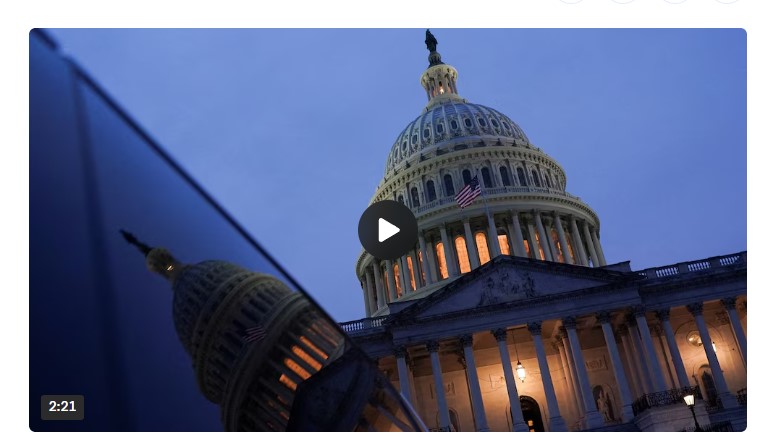
A view of the U.S. Capitol on Sept. 29, 2025 in Washington.
Anna Moneymaker/Getty Images
If Congress can’t reach a deal early in the month to spare the troops as it’s done in the past, Defense Department personnel would be forced to go without pay for what appears to be the first time in decades. In 2018, Coast Guard personnel went without pay as employees of the Department of Homeland Security.
According to a contingency plan posted by the Pentagon this weekend, all active-duty troops would be required to keep working. The plan says contracts can move forward too but under increased scrutiny with priority given to efforts to secure the U.S. southern border and build Trump’s U.S. missile shield, known as “Golden Dome.”
Middle East operations, depot maintenance, shipbuilding and critical munitions are also identified as priorities
“The department will continue to defend the nation and conduct ongoing military operations,” the plan states.
PHOTO: Congressional leaders and Vice President JD Vance address members of the media outside the West Wing at the White House in Washington, Monday, Sept. 29, 2025, in Washington.
Senate Majority Leader John Thune, R-S.D., speaks alongside Russell Vought, Office of Management and Budget director, from left, House Speaker Mike Johnson, R-La., and Vice President JD Vance, as they address members of the media outside the West Wing at the White House in Washington, Monday, Sept. 29, 2025, in Washington.
“Military personnel on active duty, including reserve component personnel on Federal active duty, will continue to report for duty and carry out assigned duties,” the document later adds.
All federal employees are guaranteed back pay under law once government spending resumes. During past shutdowns, some federal personnel struggled to continue report to work without the steady cash flow that can be used to pay for gas and child care.
About 25% of military families experience food insecurity, which is really a symptom of their broader financial stress, and about 25% of military families also report having less than $500 in savings, according to the National Military Family Association.